Solar control that stops the heat before it ever reaches the glass — the highest-impact upgrade on a hard west-facing fairway wall.
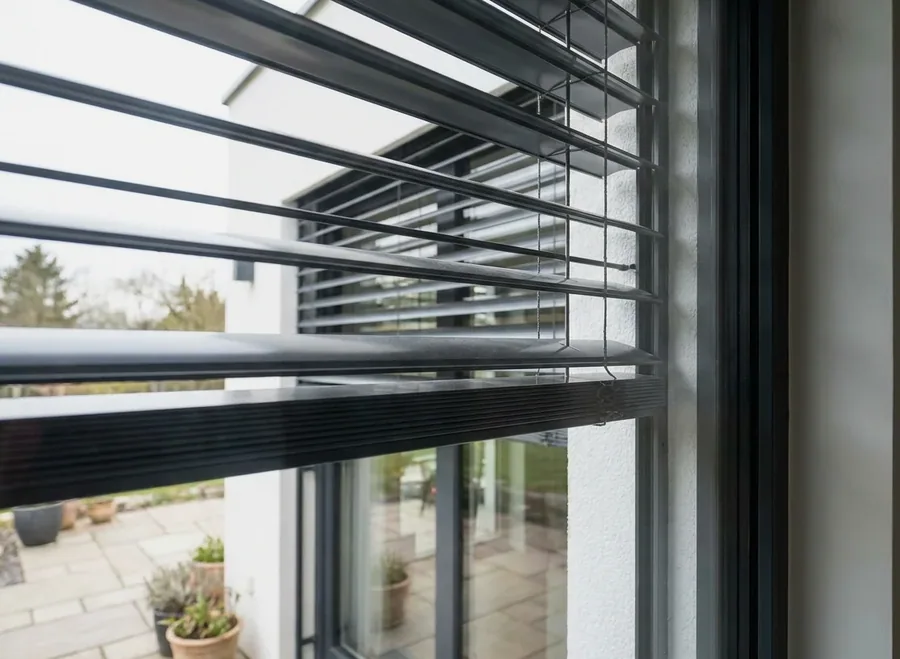
Interior blinds manage heat that's already inside the house. External venetians intercept most of it before it ever crosses the glass. On a big north- or west-facing wall of glass looking down the fairway, that difference is dramatic — it's how architects shade proper glass buildings, not just dress a window.
Wide aluminium slats, in the 60–90mm class, run in guided side rails or cables and tilt and raise much like an interior venetian — but engineered to live outside. They're effectively always motorised, with a wind sensor as standard: an exposed external blind has to protect itself the moment a highveld gust or hailstorm arrives, not wait to be rescued.
It's the assessment we make most on hard west-facing glass — the ridge-top windows of Northcliff, fairway-facing lounges in Ruimsig, and the bigger stands of Featherbrooke Estate and Constantia Kloof all get the same look before we recommend it.
This is the premium answer for a hard elevation, and the numbers reflect the engineering: without a motor, R3,000 to R4,500 for each square metre, installed, and R4,500 to R6,500 per square metre motorised. The cost is not in the slat but in the guide rails, the head box and the fixings and coatings built to stand full sun and West Rand hail for years.
A wind sensor belongs in the specification rather than on a list of extras, and it appears as its own line so you can see what it costs. Small openings carry a minimum charge. Ahead of any number there are three practical tests: the structure above the window must take the load, there must be room for the rails, and the estate must accept how it looks from outside. Each of those gets checked while we are at the house, at no cost, and if any one of them rules the system out we tell you and price an indoor answer instead.
Free in-home measure, written per-window quote, no pressure.