The everyday answer for wide, fairway-facing glass — sunscreen where the view matters, blockout where the light doesn't need to get in at all.
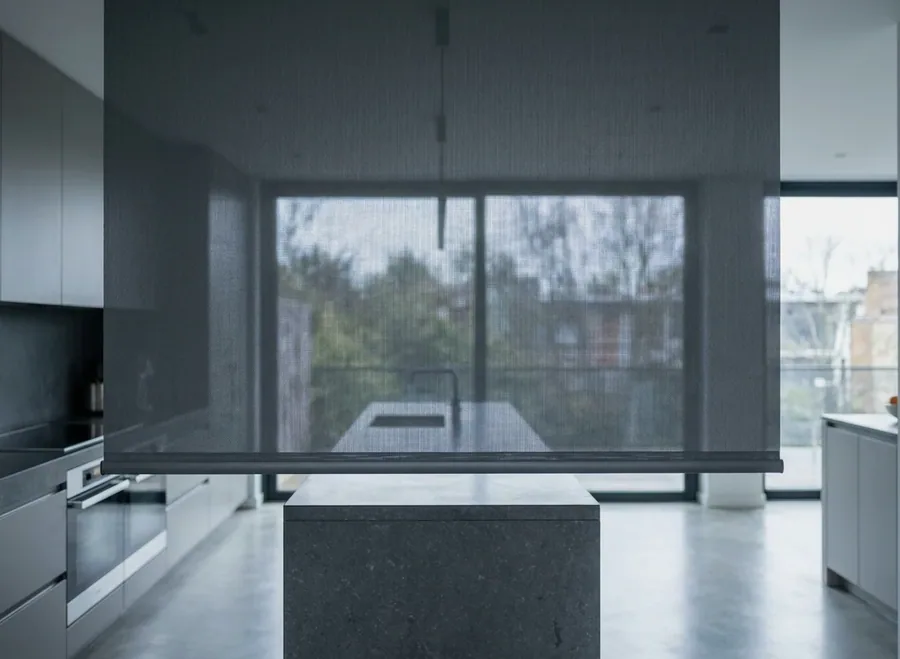
Sunscreen fabric (in 3%, 5% or 10% openness) cuts glare and UV while keeping the fairway visible through the weave — the lower the percentage, the more heat and glare it stops, at the cost of a little view. A 3–5% weave is the standard choice for the big glass most Eagle Canyon homes are built around.
Blockout fabric does the opposite job: total dark for bedrooms, nurseries and media rooms, plus a genuine insulating layer against summer heat and winter cold. It's the fabric to reach for anywhere the goal is "no light at all," not "less light."
Most bedrooms with a fairway view end up running a double roller — blockout for night, sunscreen for day, on the same headrail. It's the practical middle ground between "I want to see the ninth green" and "I want to actually sleep in."
Chain control with a wall-anchored tensioner as standard, spring-assist for a lighter action, or fully motorised for wide or hard-to-reach windows — see our note on motorised automation for linked, multi-blind runs.
The double roller — blockout for night, sunscreen for day — is the brief we fit most often: golf-facing lounges in Ruimsig, big West Rand windows in Featherbrooke Estate, ridge-top glass in Northcliff, and the established Roodepoort homes of Constantia Kloof all run the same measure.
Guides per square metre, installed, offered so you can plan rather than guess. A manual roller in blockout, sunscreen or light-filter fabric comes in between R1,000 and R1,600 per square metre. The bottom belongs to a blockout in a stock shade; a tight sunscreen in a wide fabric, or the double bracket that carries both cloths on one window, sits high in it.
Motorised, the same unit costs R2,500 to R3,800 a square metre, which takes in motor, handset or wall switch, and getting it all running on the day. Two provisos. Small windows carry a minimum charge, since a narrow opening requires the same tube, the same brackets and much the same effort as a wide one. And a range is not a quotation — the figure that binds is written per window after the free measure.
Free in-home measure, written per-window quote, no pressure.